
Back to blog
You Received the Diagnosis. Now What?
A practical, father-written guide for parents after a new autism diagnosis: what not to do, what helps, Hungarian support options, and how to find a good special education professional.

You received the diagnosis.
Now you are home. Your child is playing. You are putting things away in the kitchen. Everything looks the same as it did this morning, but your world has shifted a little.
I have been there too.
The next morning, I did not know what to do. I opened an empty browser window and stared at it. What should I even type? "What to do after an autism diagnosis?" I typed it. The first result was a professional PDF full of severity scales. I closed it. The next was a forum where parents recommended diets to one another. I closed that too.
At the time, I did not know that closing both tabs was the first thing I did right.
This is the article I wish I had found then. Not a medical protocol. Not an academic paper. Just a father writing to other parents after walking through the same doorway.
If you are sitting in front of that empty browser window now: read this. Then close it. Then go and play with your child. That is part of the guide too.
The First Weeks — Do Not Rush
The first thing I want to say is this:
the diagnosis is not a deadline.
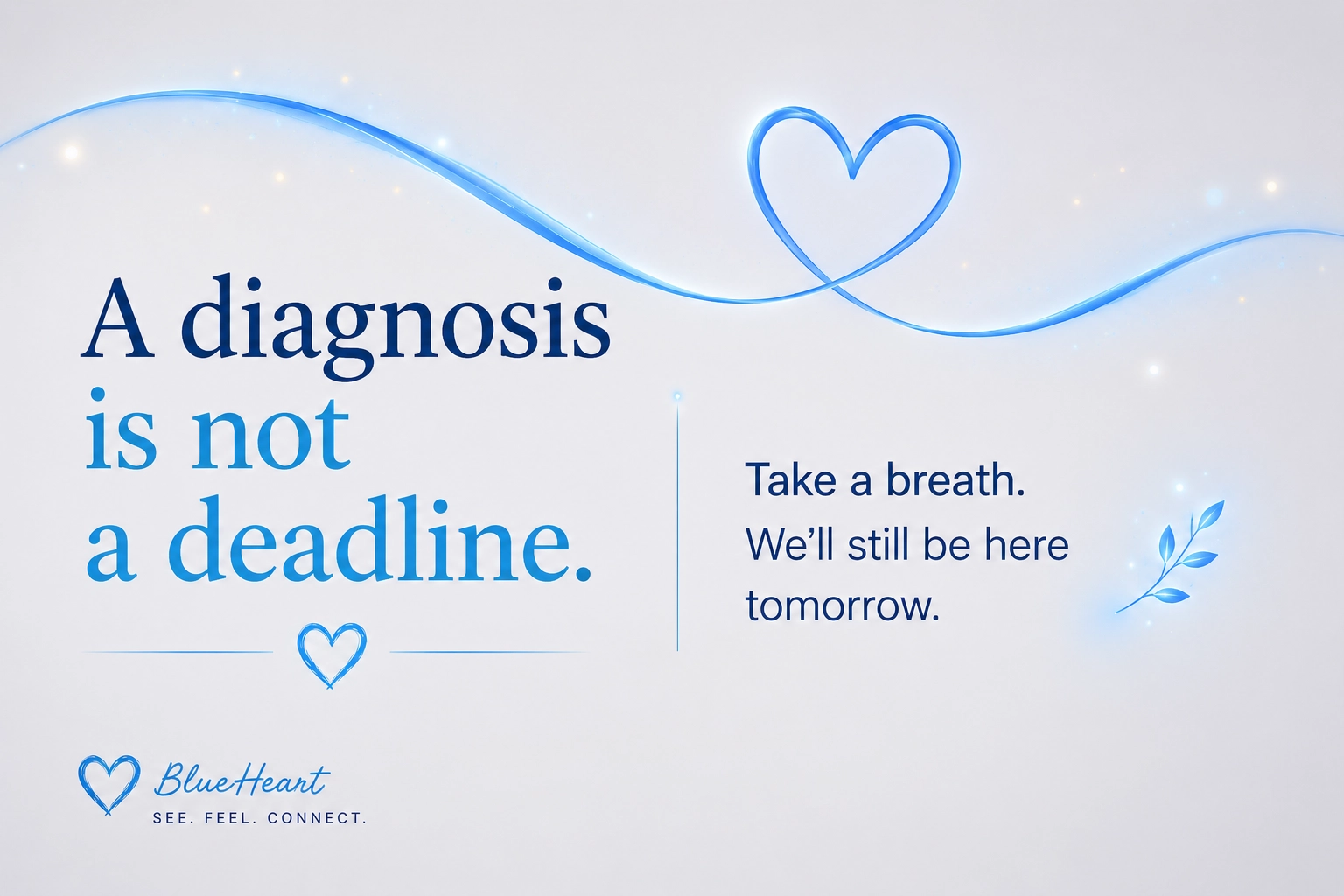
Your child is the same child they were yesterday. The same child they were an hour before you walked into the appointment. Autism did not begin on the day someone said it out loud. And nothing gets worse because a few days pass before you "do something".
In the first days, many parents fall into a strange race.
We need everything now. The best therapist now. The best method now. Appointments, forms, books, groups, decisions. Now, now, now.
But that rush is not really for the child. It is for us. It keeps us busy so we do not have to feel how lost we are.
The good news: you do not have to understand everything in the first week.
Allow the feelings. Anger, denial, relief, grief. They are all valid, and they can arrive at the same time. I wrote more honestly about that first night in my article about the day of diagnosis.
And do not make huge decisions immediately. Do not quit your job, sell anything, or pay for five different therapies by tomorrow morning. The first two or three weeks are not mainly about logistics.
They are about letting the news find a place inside you.
What NOT to Do in the First Weeks
Do Not Read Clinical Literature Yet
The temptation is strong. You want to prepare. You want to understand. You open scientific articles, assessment scales, therapy protocols.
Do not do that yet.
Clinical literature is written for professionals. It thinks in symptom lists, syndromes, prognosis, and severity levels.
Your child is not a syndrome. Your child is the one who ate breakfast with you this morning. The one who laughed at something you did not even notice. The one who holds the spoon in their own particular way.
Clinical documents will not describe that child. They often describe extremes, and those extremes can knock you down before you have even begun to understand what is happening.
You can read later. Parent stories. Practical guides. Texts written in human language. If you want to understand terms like neurodivergent, neurotypical, and neurodiversity, I wrote a plain-language article about them.
But close the severity scales for now.
Do Not Travel Through All of Dr. Google in One Night
We know how this goes.
It is two in the morning. The kitchen light is still on. Fifteen tabs are open. You are reading about causes, outlook, adult life, worst-case scenarios.
The next morning you sit beside your child more tired, more afraid, and less present.
Your child needs a rested parent more than they need a parent who read every frightening article at 3 a.m.
This also applies to AI assistants. ChatGPT, Gemini, Claude, any of them. They can be useful tools, but they do not know that you are a newly shocked parent unless you guide them very carefully. They can give you too much, too fast: scales, statistics, prognosis, lists of every possible difficulty.
Use AI for practical questions, not existential panic.
Better prompts:
- "How can I make our home calmer for a sensory-sensitive child?"
- "What playful fine-motor activities can I try with a four-year-old?"
- "How do I explain SNI to a grandparent in simple language?"
Worse prompts:
- "Tell me everything about autism."
- "What will my child be like as an adult?"
- "What is the worst that can happen?"
AI is a tool. A useful one, if you use it for the right job.
Do Not Fall for Miracle Cures
This is the hard part, and I want you to keep it close:
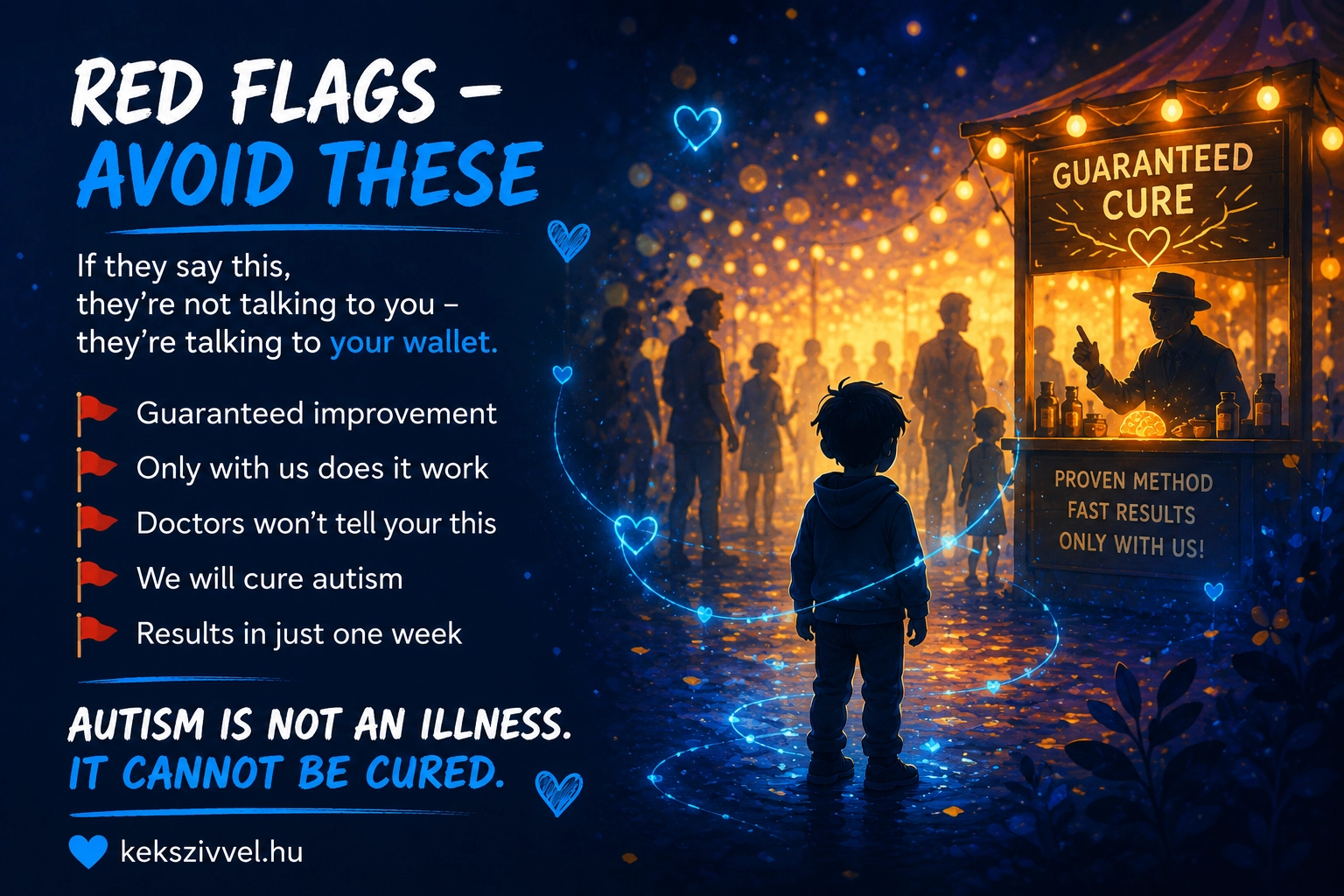
Autism is not an illness. It cannot be cured.
If someone promises a cure through a diet, detox, supplement, natural treatment, expensive program, or distant clinic, they are not telling the truth.
A child cannot be cured of who they are.
That does not mean support is useless. Good development, therapy, movement, communication support, and family guidance can help enormously. But "cure" is a red flag.
Watch out for:
- "Guaranteed improvement", "100% success", "proven results" — serious professionals do not promise this
- "Only we know this", "secret method", "doctors do not want you to know"
- High upfront payments tied to pressure
- Detox, chelation, extreme diet protocols — these can be dangerous and are not autism treatment
- "Results in one week" — nervous-system development does not work that way
One question helped me:
If this expensive thing does not work, will I still believe in my child the same way?
If money and desperate hope become tied together, every ordinary day can start to feel like failure. That is bad for your child, and for you.
What TO Do — First Steps
Keep What Already Works
Here is a rule from our own life:
Anything that means being together with your child usually helps.
Drawing. LEGO. Origami. Scooters. Walking. Emptying the dishwasher together. Singing in the bath. Stopping in the street because they are watching a bus.
Nobody calls these things therapy.
But in a human sense, they are.
Shared attention, safety, play, and connection support the nervous system, emotional regulation, and trust. Maybe you cannot measure them. Maybe no protocol lists them. But they do not harm.
So in the first weeks, do not stop the things that already work. Keep the rituals, the laughter, the small shared moments.
Professional support should build on that, not replace it.
Find a Special Education Professional
The psychiatrist may give the diagnosis, but they will not be the person walking beside your family every week.
What many families need next is a special education professional: someone who works regularly with your child and, just as importantly, with you.
Because the parent is part of the development process.
A good specialist does not only work with the child. They teach you how to approach them, what signs to watch, how to read behavior, how to respond to a meltdown, and how to build daily support at home. That knowledge is priceless, because you are with your child far more than any professional.
Signs of a good specialist:
- They work with you too, not only the child.
- They observe first, instead of immediately forcing tasks.
- They are regularly available, ideally weekly or every other week.
- They name concrete goals, such as dressing, shared attention, transitions, or communication.
- They never promise a cure.
- They are transparent about training and keep learning.

Take these points with you to the first meeting. If one thing is missing, that may not be fatal. If several are missing, keep looking.
And remember: the first person you meet may not be the one you work with for years. That is normal. This is a relationship too.
Movement Matters More Than Many Parents Think
In the first weeks, many parents think only about speech, behavior, or cognitive development.
That is understandable.
But movement can matter deeply too.
Balance, coordination, body awareness, and sensory integration all support later skills: attention, fine motor control, writing, even communication.
In Hungary, several legitimate approaches exist, including:
- Alapozó Terápia
- TSMT (planned sensorimotor training)
- Sensory integration / Ayres therapy
These are not autism cures. They are supportive developmental approaches. Some children benefit a lot, others less visibly. You cannot know in advance.
But safe, playful movement itself is good for the body.
You can also begin at home: climbing, jumping, balancing, scooting, crawling, carrying objects, playful obstacle courses.
Two Pillars, Not Rivals
Parents often ask: special education or movement therapy? Which is more important?
They are not enemies.
They are two different pillars.
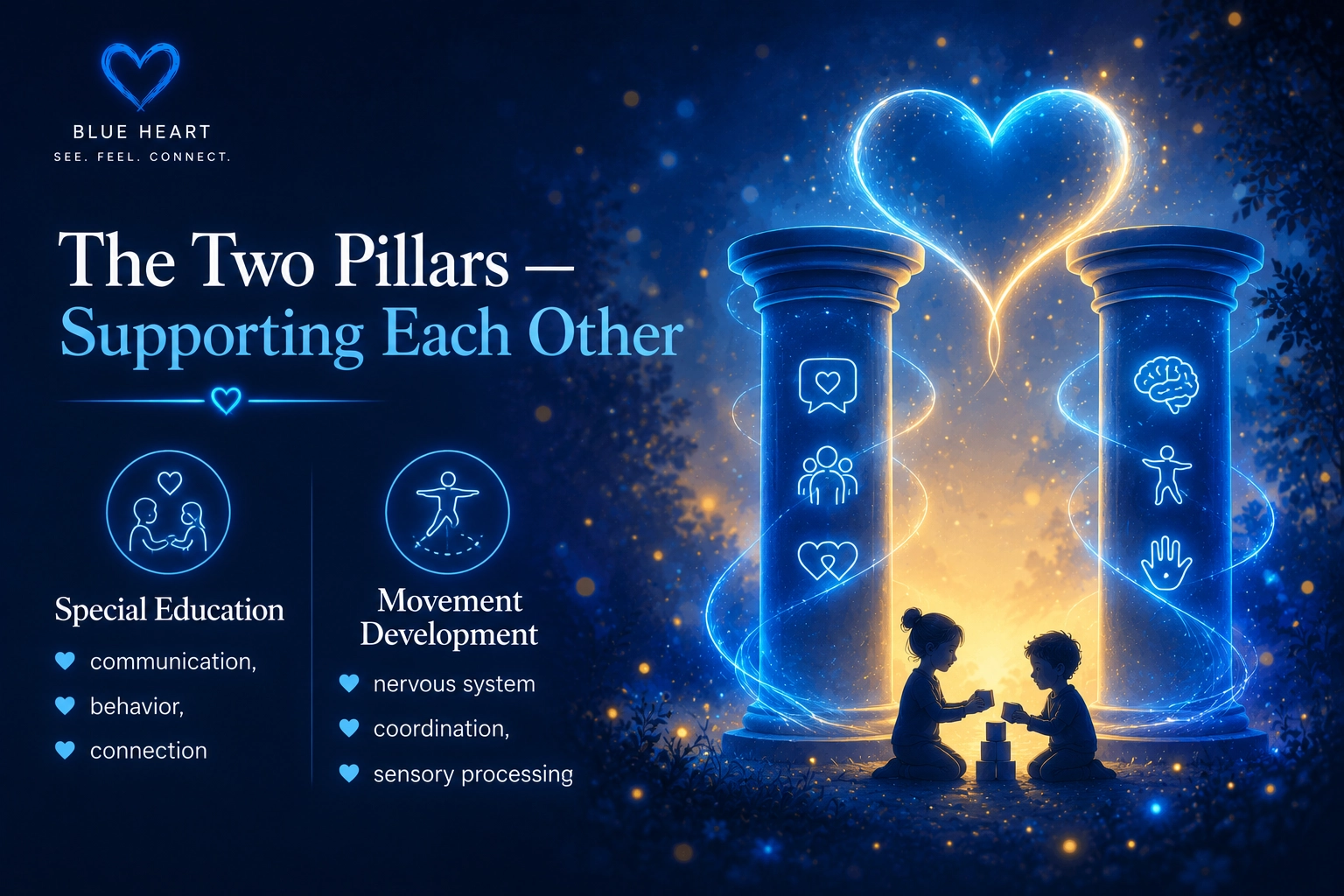
| Area | Who can help? | Goal | |---|---|---| | Communication, behavior, connection | Special education professional with autism-specific training | Understanding, expression, independence, social skills | | Nervous-system maturity, movement, sensory processing | Alapozó therapist, TSMT specialist, Ayres therapist | Coordination, attention, sensory integration, reflex integration |
If money allows only one at first, start with the special education professional. Movement can begin playfully at home and be added later with a specialist.
Find Community Carefully
Find people who understand.
But be careful where you look.
Large public Facebook groups can be rough. Some will recommend miracle cures within half an hour. Some become places of blame and argument. In the first weeks, that can hurt more than help.
Small peer circles are often better. Places where you do not have to explain everything first. Where nobody throws "solutions" at you. Where one sentence is enough.
I wrote more about this in the article on the power of community.
The Hungarian Reality — What to Check
The next part is practical. It is about Hungarian support systems that can matter in everyday life.
Important: amounts, conditions, and application processes change. Always check official sources or ask at the kormányablak before you act.
Things worth checking:
- Higher family allowance through the Magyar Államkincstár: family allowance page
- Additional paid leave for both parents, often connected to proof of higher family allowance
- Yellow travel card for discounted or free transport for the child and accompanying adult
- Free or discounted meals in kindergarten/school, often one of the largest monthly savings
- GYOD and extended GYES, which have different conditions and work rules: csalad.hu GYOD, TASZ guide
- NAV family tax allowance: NAV page
- Parking card, vehicle tax exemption, and other benefits, depending on conditions
The autism diagnosis usually appears in the Hungarian medical system under an F84.x BNO code. Some supports may become easier once the doctor records the diagnosis and issues the right certificate, but never assume anything is automatic. Ask.
One honest note: long lists of organizations can look helpful on paper. In real life, capacity and distance can make regular help hard to access. Try local organizations, AOSZ, EGYMI, and foundations, but do not build your weekly routine on a promise that may not become practical. A steady specialist and a workable family rhythm matter more.
SNI or BTMN?
Many parents fear the word SNI.
"Will this label follow my child? Will it mark them?"
I understand the fear. But it helps to reframe it.
SNI is not a stamp of failure. In the Hungarian education system, it is often the key that opens access to state-funded support, special education services, accommodations, and an individual pace of learning.
An autism diagnosis is medical. SNI is an educational category established by the expert committee of the pedagogical service. Both may be needed once your child enters kindergarten or school.
BTMN is different. It refers to integration, learning, and behavioral difficulties, often milder or more temporary. Autism belongs under SNI, not BTMN, in the Hungarian public education framework.
With SNI, your child may be entitled to special support, integrated education if recommended, exemptions in certain areas, and an individual learning path.
The expert committee assessment usually involves your child and results in an official opinion that the institution must follow.
You, Your Partner, and the Family
The diagnosis puts stress on a relationship too.
You and your partner may process it differently. One person wants to talk. The other goes quiet. One reads everything. The other works in the garage or stares at the television. Neither is automatically wrong.
But it can become painful if you misunderstand each other.
Things that helped us:
- Talk about how you are processing, not only about the child.
- Divide the administrative load. One parent handles NAV papers, the other the expert committee. One organizes weekly therapy times.
- Remember siblings. If there is a brother or sister, this changes their life too. They need age-appropriate truth and space for their feelings.
And take care of yourself.
Sleep. Move. Find at least one person you can tell the truth to: a friend, sibling, fellow parent, therapist, anyone.
A burned-out parent cannot be present.
And a present parent is one of the strongest supports a child can have.
About the Future
I know the question burning in you:
What will happen to my child in twenty years?
Nobody can answer that now. Not a doctor, not a therapist, not me.
But I want you to know this: many people have walked ahead of you. Scientists. Actors. Athletes. Parents. Ordinary adults we never hear about, living full lives.
In the Blue Flame series, we regularly share portraits of people who have spoken openly about their different minds. They do not say everything was easy. They say: it was hard, and there was a way through.
That is not a promise about your child.
It is a reminder that a diagnosis is not a life sentence.
Acceptance Begins Inside
If you have read this far, thank you.
This was a lot. You may forget half of it by tomorrow morning, and that is fine. The article will stay here. You can come back.
One thing matters most.
For a long time, I waited for acceptance from others. Strangers at the playground. Relatives. School. The world.
"If only they would accept my son as he is."
Then one evening, in an ordinary bedtime moment, I understood that acceptance does not begin somewhere outside. It begins when I accept him as he is.
I wrote more about that in this article.
The diagnosis is not the end of your life. It is a doorway. On one side is the parent who did not know yet. On the other is the parent who now does.
You do not have to accept everything today.
Just watch your child.
They may already know how to be themselves.
You are not alone. 💙

Frequently Asked Questions
When should we start developmental support?
When you are ready enough to begin. In general, it is worth starting the search for a special education professional in the first month, but do not panic. "The sooner the better" does not mean three new therapies every week. A good weekly specialist plus your shared time at home is enough for a start.
Who do I have to tell about the diagnosis?
Only as many people as you choose. There is no need to tell every relative or friend. It is usually worth telling kindergarten or school so they can provide support, especially once you have the expert opinion. At work, it may come up when requesting additional leave, but otherwise you decide what to share.
Can an autistic child join a community?
Yes, and in many cases it is recommended. With an autism diagnosis and SNI classification, the child may be entitled to integrated education or special education provision, depending on the expert committee's recommendation.
How much money does support mean monthly?
It depends on which supports you qualify for and how you decide about GYES/GYOD. Higher family allowance, meals, travel discounts, and extra paid leave can already matter. GYOD can make a larger difference. For current amounts, always check the Magyar Államkincstár and official sources.
Does one parent have to stay home?
Not necessarily. Work is possible alongside GYES and GYOD, but the rules differ. Check current conditions at csalad.hu and with the kormányablak before planning working hours.
What should I tell a sibling?
Tell the truth at their age level. A younger child may only need: "Your sibling has a harder time with sounds, lights, or new places, so we help him." An older child can hear more about the diagnosis in your own words.
Can we have another child?
That is deeply personal. My only advice: do not decide in the first weeks. Shock and grief are not the best place for life-changing decisions. Give yourselves time, talk honestly, and ask for genetic counseling if you want facts. The final decision belongs to your family.
Further Reading — Hungarian Sources
- Magyar Államkincstár — Family allowance
- csalad.hu — GYOD
- NAV — Higher family tax allowance
- Egészségvonal — Higher family allowance
- Mosoly Fejlesztőház — Autism-related entitlements by BNO code
- AOSZ Infóbázis — GYOD and autism
- TASZ — Who can receive GYOD and how to apply
- auti.hu — Development types and places in Hungary
- Rosa Parks Foundation — Legal guide for SNI children's education rights
If you read this far, please also follow Kékszívvel on Facebook. That is where I share weekly thoughts and where our slowly growing community is taking shape.
The day of diagnosis shakes many things. But from that day on, every day also teaches you a little more about your child. And every day can bring you a little closer to acceptance, from the inside outward.
💙
Oszd meg:Facebook